 listicle
ResumeWorded Alternative for Job Seekers: 8 Tools Tested
Table of Contents
- Quick Comparison: 8 ResumeWorded Alternatives
- What to Look For in a ResumeWorded Alternative
- The Best ATS Resume Checker Options for Job Seekers
- Jobscan: The Industry Standard for Keyword Matching
- Teal: Best Free Platform for Application Tracking
- Upplai: Pay-Per-Use Model with Transparent AI Editing
- Rezi: Best for Building an ATS-Friendly Resume From Scratch
- Jobsolv: Best for Short, Intense Application Sprints
- SkillSyncer: Best Budget Option for Keyword Scanning
- AIApply: Best for Automating the Whole Application Workflow
- ResumeFast: Best for a Quick, Free Compatibility Check
- Matching the Tool to Your Industry
- How to Optimize Resume Content for ATS
- How to Tailor a Resume for a Specific Job Description
- Privacy and Data Security: What Resume Tools Do With Your Data
- Conclusion
- Frequently Asked Questions
Last Updated: September 16, 2026
Quick Comparison: 8 ResumeWorded Alternatives
Job seekers searching for a resumeworded alternative want accurate ATS feedback, fair pricing, and control over their data. This TemplateForge guide compares eight tools using real product data, not affiliate hype.
Here's the short version before the detail:
| Tool | Pricing Model | Free Tier | Best For |
|---|---|---|---|
| Jobscan | Subscription | Yes | Keyword matching against a specific posting |
| Teal | Freemium | Yes | Tracking applications end to end |
| Upplai | Pay-per-use | Yes | Avoiding a recurring charge |
| Rezi | Freemium | Yes | Building an ATS-friendly resume from scratch |
| Jobsolv | Pay-per-pass | Yes | Short, intense application sprints |
| SkillSyncer | Subscription | Yes | Budget keyword scanning |
| AIApply | Subscription | No | Automating the whole application workflow |
| ResumeFast | Freemium | Yes | A quick, free compatibility check |
What to Look For in a ResumeWorded Alternative
The right alternative depends on which part of the process you need help with: scoring, editing, or tracking. Most job seekers overpay for features they never open. The two variables that change your outcome are how the tool scores your resume and how it charges you.
ATS Scoring Accuracy and Keyword Matching
Applicant tracking systems parse resumes into structured fields before a human sees them. A scanner that reports a high score but misses how the parser reads your file format is worse than none.
- Hard-skill keyword matching against a pasted job description, not just a generic keyword bank.
- Format diagnostics that flag tables, text boxes, headers/footers, and graphics that break parsing.
- Section recognition, does the tool correctly identify your Experience, Education, and Skills blocks, or does it mislabel them?
Pricing Models: Subscription vs. Pay-Per-Use
Subscription tools reward long job searches; pay-per-use tools reward short ones. Applying for three months? A subscription can cost more than a one-time pass. Sending two applications this week? A pass wins.
- Billing cadence. Monthly plans often auto-renew at the same rate; annual plans advertise a lower monthly figure but lock you in for twelve months. Divide the annual total by twelve to see the real monthly cost.
- Cancellation window. Some tools let you cancel anytime and keep access until the period ends; others require cancellation before a specific date or you're charged again.
- Refund policy. Most resume tools do not offer refunds on digital subscriptions once you've used the service. Read the terms before you upload, not after.
- Free-tier limits. A "free" tier that caps you at one scan per month is a trial, not a free tool. Check the cap before you build a workflow around it.
Industry-Specific Fit: Why One Tool Doesn't Serve Every Field
Most comparison articles treat resume tools as interchangeable. They aren't. The tool that works for a software engineer is often wrong for a nurse, a teacher, or a graphic designer, because each field's hiring pipeline reads resumes differently.
- Tech and engineering roles tend to run through high-volume ATS platforms and lean heavily on exact-match technical keywords (languages, frameworks, tools). Keyword-matching scanners with strong hard-skill detection perform best here.
- Healthcare roles often require license numbers, certifications, and credential formatting that generic scanners don't recognize. A tool that flags missing credentials is more useful than one that only counts keywords.
- Creative roles (design, marketing, copywriting) frequently need portfolio links and visual formatting that ATS parsers strip. Here, the priority is a scanner that tells you what visual elements will survive parsing, not one that pushes you toward a plain-text template.
- Sales and operations roles reward quantified achievements. A scanner that flags missing metrics is more valuable than one that only checks keyword density.
The Best ATS Resume Checker Options for Job Seekers
The best ATS resume checker matches your timeline, budget, and industry, not the longest feature list. Here's how the eight tools compare.
Jobscan: The Industry Standard for Keyword Matching
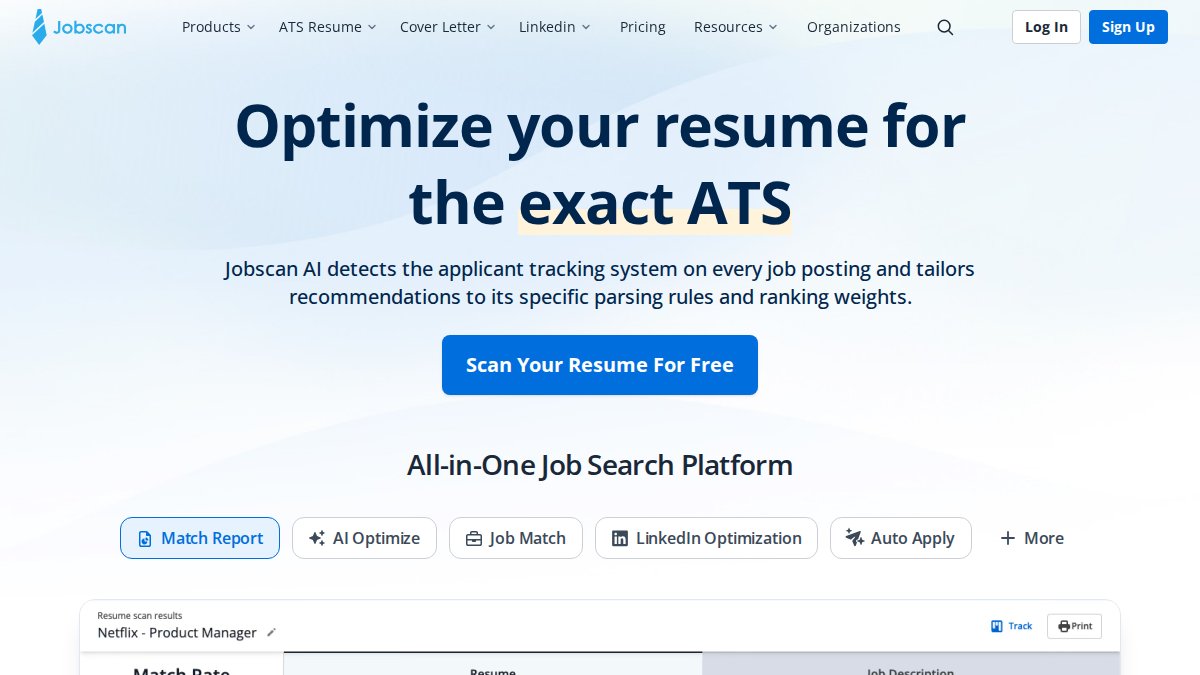
Jobscan compares your resume directly against a specific job description and reports keyword gaps. It's the tool most recruiters have heard of, and its job-to-resume comparison is genuinely specific.
Teal: Best Free Platform for Application Tracking
Teal bundles a resume builder, a job tracker, and a Chrome extension into a free-forever tier. The tracking side is the differentiator: log applications, notes, and follow-ups in one place instead of a spreadsheet.
Upplai: Pay-Per-Use Model with Transparent AI Editing
Upplai offers real-time ATS scoring with AI-driven editing suggestions and usage-based pricing. If you dislike subscriptions on principle, look here.
Rezi: Best for Building an ATS-Friendly Resume From Scratch
Rezi is a resume builder first and a scanner second. Its templates use parser-friendly structure, and it scores your resume as you write. If your current resume is a formatting disaster, starting fresh in Rezi is often faster than repairing the old file.
Jobsolv: Best for Short, Intense Application Sprints
Jobsolv sells access passes rather than monthly subscriptions, fitting job seekers who apply in concentrated bursts. The pass model avoids the auto-renew trap of monthly plans.
SkillSyncer: Best Budget Option for Keyword Scanning
SkillSyncer focuses on keyword scanning, a reasonable fit for a second opinion on keyword coverage without premium rates.
AIApply: Best for Automating the Whole Application Workflow
AIApply bundles resume tailoring, cover letter generation, and application automation into a subscription, aimed at high-volume applicants who want less manual work per application.
ResumeFast: Best for a Quick, Free Compatibility Check
ResumeFast offers a fast, free compatibility check, useful as a first pass before paying for a tool. Run your resume through it to catch obvious parsing problems, then move to a detailed scanner for keyword work.
Matching the Tool to Your Industry
None of the top comparison articles segment these tools by field, and that's a real gap. The right pick depends on how your industry hires:
- Tech and engineering: Jobscan or SkillSyncer for hard-skill keyword matching.
- Healthcare: Rezi for credential-friendly structure; verify license and certification fields survive parsing.
- Creative: Rezi or Teal for portfolio-link handling; avoid tools that push plain-text templates.
- Sales and operations: Jobscan for quantified-achievement feedback.
- High-volume applicants: AIApply for automation; Jobsolv for burst-mode passes.
How to Optimize Resume Content for ATS
Optimizing resume content for ATS means writing for two readers: the parser that extracts your data and the hiring manager who reads it afterward. The parser goes first.

How to Tailor a Resume for a Specific Job Description
Tailoring a resume for a specific job description is a 20-minute exercise, not a rewrite. The goal is alignment, not fabrication.
Work through it in this order:
- Copy the job description into a separate document and highlight every required skill and tool
- Check which of those terms already appear in your resume, verbatim
- Rewrite your professional summary to lead with the two or three requirements you match strongest
- Reorder bullet points so the most relevant achievement sits first under each role
- Swap generic action verbs for the posting's own vocabulary where it's accurate
- Re-run the tailored version through your scanner and compare scores
Privacy and Data Security: What Resume Tools Do With Your Data
Resume tools handle some of your most sensitive information: your address, employment history, and sometimes salary expectations. Most competitors gloss over this entirely.
The practical questions to ask before uploading anything:
- Does the tool store your resume after you delete your account, and for how long?
- Can you use the scanner without creating a profile tied to your real identity?
- Does the privacy policy allow your data to be used for training models or sold to third parties?
- Is there a documented deletion process, or just a support email address?
Conclusion
The hardest part of a job search isn't finding tools; it's choosing one and using it consistently. A scanner you run once tells you almost nothing. A scanner you run against every application, with a tailored resume each time, compounds into real interview invitations.
Frequently Asked Questions
Is there a free alternative to ResumeWorded?
Yes. Teal and Rezi both offer free-forever tiers with resume building and ATS optimization features. Teal includes a job application tracker and Chrome extension for job board integration. Rezi focuses on ATS-compatible formatting and AI content generation. Both let you test core features before paying. Jobsolv also offers short-term access passes, and ResumeFast provides free ATS compatibility scanning. These free options work well for job seekers who want to evaluate tools before committing to a subscription.
Which resume optimization tool is most accurate for ATS?
Jobscan is widely considered the industry standard for ATS keyword matching. It compares your resume directly against specific job descriptions and identifies skill gaps. For accuracy, test your resume through two or three tools. Each uses different parsing algorithms, so results vary. The best ATS resume checker will show you exactly which keywords are missing and how to fix formatting issues that block parsing.
Do resume scanners actually help you get more interviews?
Resume scanners help you pass automated filters, which is the first step to getting an interview. They identify keyword gaps, formatting errors, and missing skills that cause rejection before a human sees your resume. However, scanners cannot fix weak experience or unclear achievements. Use them alongside how to tailor a resume for a specific job description. The combination of ATS optimization and genuine job description alignment gives you the best chance of reaching a hiring manager.
How do I know if my resume is ATS-friendly?
Run your resume through a free scanner like ResumeFast or SkillSyncer. These tools check for formatting issues that break ATS parsing, such as tables, columns, graphics, and non-standard fonts. They also flag missing keywords. Your resume should use a single-column layout, standard section headings, and a common file format like .docx or .pdf. After scanning, use how to optimize resume content for ATS techniques: add relevant hard skills, mirror job description language, and quantify achievements with numbers.
Are AI resume builders worth the cost for job seekers?
AI resume builders save time on formatting and keyword optimization, especially when applying to many jobs. Teal offers a robust free tier. If you are applying to five or more jobs per week, a paid tool pays for itself by reducing manual tailoring time. For occasional applications, free tools or short-term passes from Jobsolv work well. The value depends on your job search volume and how much time you want to save.